

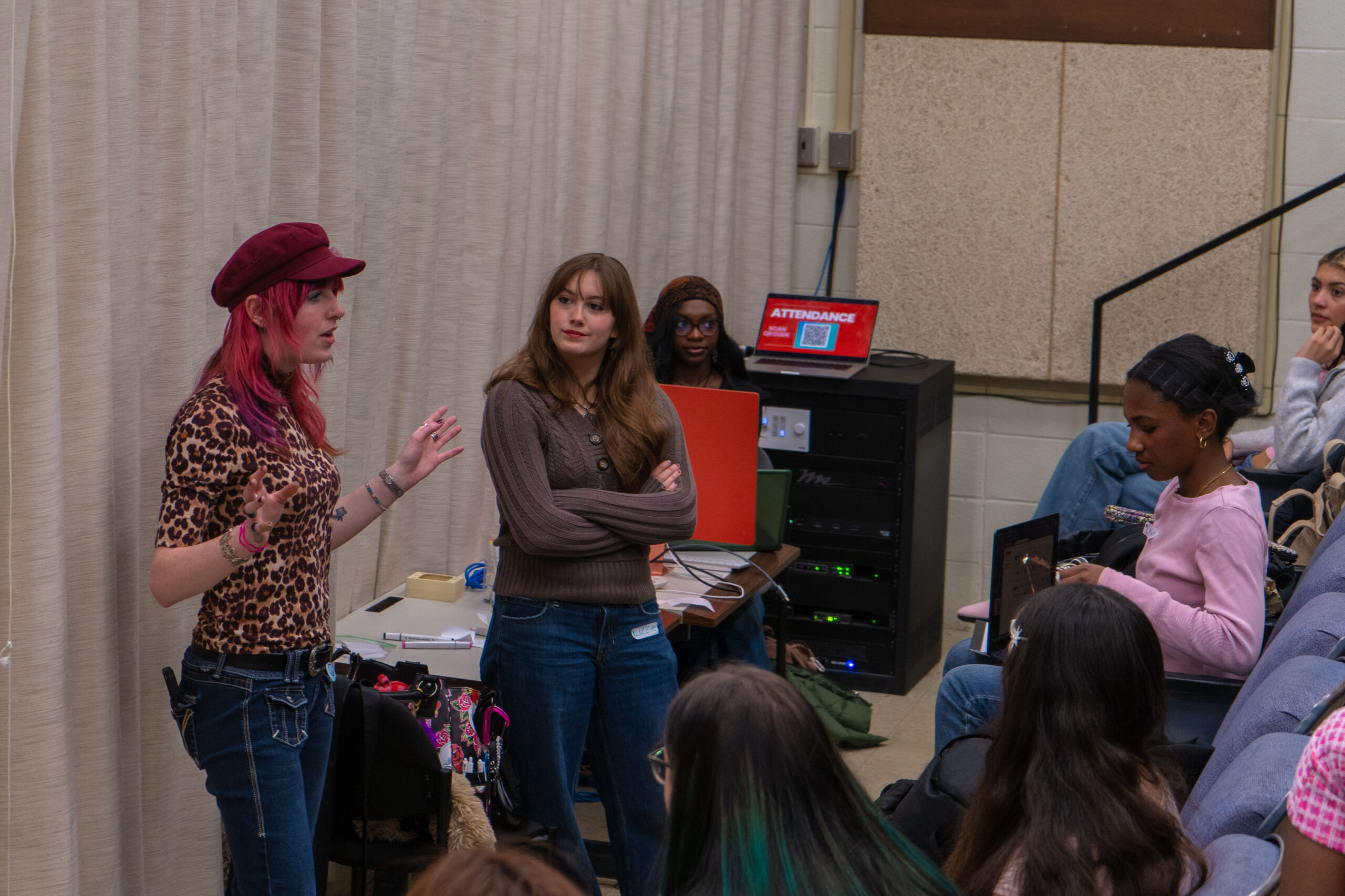
We Need To Talk (WNTT) is a program run on TUTV, an award-winning, student-run digital cable station. The program features a diverse group of women covering topics like current events in politics, fashion and beauty trends, pop culture, and college life. WNTT creates a space for women to collaborate, be creative, gain experience, and share their passion for content production.
Elizabeth (Lizzie) Pegg and Sawyer Fierce are the co-executive producers of We Need To Talk. They are both part of the 2028 graduating class. Other leaders of WNTT are Chloe Pabon, co-host and producer; Amaica Reid, director and producer; and Trinity Jefferson, producer and floor director.
Pegg, a film major, describes WNTT in three words: “Virtuous, matriarchal, and advocation. We want to create a space where women aren’t held down by stereotypes; a creative space where we can prosper and give ourselves a voice.”
Both Fierce and Page are rooted in the belief that everyone should feel heard, seen, and represented. They want to use their platform to advocate for those who don’t have the privilege or platform to do so, and to stand up for what is right. They are both dedicated to shaping the future of WNTT and continuing to include a diverse team. After holding their first official meeting of the spring semester, Pegg notes that the turnout was incredible.
“There was a collective feeling in that moment of, ‘we did this,’” Pegg said. “We felt so proud of the space we had created, and I love being a part of this show because it helps me contribute to the fight for feminine presence in not only creative fields, but any field we can reach.”
For co-executive producer Fierce, the experiences, friendships, and memories made with WNTT go beyond just passion. Fierce switched from an English major to media studies and production in the spring of 2025 after inspiring conversations they had when they were still a general member. This is one example of how WNTT gives space for people to find themselves and express themselves authentically.
“Bringing our honesty to topics that aren’t mentioned in mainstream media is why I joined WNTT,” said Fierce. “I wanted to express my thoughts through a collective perspective, as someone who aligns with womanhood. It brought out a true version of who I am, and I came to life on the screen.”
Through the long, grueling, sometimes even late-night hours put into WNTT, the co-executive producers are very proud of their team and what is being brought to fruition. The dedication and creativity of women and women-adjacent in this program are unique. Through collaboration, open communication, and support, they consider themselves a family.
Showing vulnerability by having honest conversations about their personal lives allows the show’s success to unfold further, breaking down barriers around stigmatized topics. In the works right now is a podcast so members can have more space to talk about their personal lives and experiences, with constant encouragement for everyone to be in front of the camera at some point.
“I hope viewers feel that there are spaces for solely women. While there are very few spaces, we are making them, and dismantling this patriarchal aspect of media is achievable,” said Fierce. “It takes courage to speak, on screen, our thoughts, but we do it because this is what we need in the human race. We need to talk.”